
Broiler Feed Cost Per Chicken in Nepal: A Complete Guide
Ask any broiler farmer in Nepal what worries them most at the end of a batch, and the answer is rarely the chicks, the labour, or even the market rate. It is the feed bill. Feed quietly eats up the biggest share of every rupee spent on raising broilers, and a small change in feed price or feed efficiency can turn a comfortable profit into a thin one within a single cycle.
According to a recent survey by the National Statistics Office, commercial poultry farms in Nepal spent roughly Rs79 billion on operational and capital expenditure, and feed purchase alone accounted for around Rs53.98 billion of that. That means close to 68 percent of total spending went into feed. For a sector that produces over 258,000 tonnes of broiler meat every year, knowing the feed cost per chicken is not a minor detail. It is the starting point for almost every financial decision a farmer makes.
The purpose of this article is to explain how broiler feed cost per chicken is calculated in Nepal, what a typical figure looks like, which factors push it up or down, and what practical steps farmers can take to keep it under control. SB Group’s Jio Feed range is formulated with these realities in mind, helping farmers get predictable performance from every kilogram of feed they buy.
What Does Broiler Feed Cost Per Chicken Mean
Broiler feed cost per chicken is the total amount spent on feed to raise one bird from day one until it reaches market weight. It is calculated by multiplying the total feed one bird consumes by the price of that feed. Because broilers eat different feeds at different stages of their life, the figure is usually worked out stage by stage and then added together.
It is also useful to express feed cost per kilogram of live weight. This tells you how much you are spending on feed to produce each kilogram of chicken that you will eventually sell, and it makes it much easier to compare one batch against another, or one feed brand against another.
Why Feed Cost Per Chicken Matters So Much
Feed is the largest single input in broiler production, and unlike some other costs, it changes with every batch. Chick prices, vaccines, and labour are relatively predictable. Feed prices move with raw material markets, and feed consumption moves with the health and management of the flock.
Tracking feed cost per chicken helps farmers in several ways:
- Pricing decisions: It shows the minimum live weight price needed to break even on feed before any other cost is counted
- Feed comparison: It allows a fair comparison between brands, since a cheaper feed that performs poorly can end up costing more per bird
- Early warning: A sudden rise in cost per bird usually points to a problem such as disease, heat stress, or feed wastage
- Planning: It helps farmers estimate working capital for the next batch and avoid running short mid-cycle
- Profitability: Because feed makes up such a large share of total cost, it is the most effective place to look for savings. Anyone interested in the broader picture can read more about poultry farming in Nepal and how returns are usually structured.
How to Calculate Broiler Feed Cost Per Chicken
The calculation is straightforward once you know the feed conversion ratio, or FCR, of your flock. FCR tells you how many kilograms of feed a bird eats for every kilogram of body weight it gains.
Feed Required Per Bird (kg) = Target Body Weight (kg) x FCR
Feed Cost Per Bird (Rs) = Feed Required Per Bird (kg) x Average Feed Price (Rs per kg)
For example, if a broiler reaches 2.2 kg at 42 days and the flock FCR is 1.7, the feed required is 2.2 x 1.7, which comes to about 3.74 kg per bird. At a blended average feed price of around Rs54 per kg, the feed cost per bird works out to roughly Rs200.
To find the cost per kilogram of live weight, simply divide the feed cost per bird by the body weight. In this example, Rs200 divided by 2.2 kg gives a feed cost of about Rs92 per kg of live chicken.
Farmers who want to understand how daily consumption feeds into these numbers can also look at the feed intake formula in poultry, which explains how to estimate and monitor how much feed each bird should be eating at every age.
Typical Feed Cost Per Chicken in Nepal Stage by Stage
Broilers in Nepal are usually fed in three phases: starter, grower, and finisher. Each phase has its own protein level, and each is priced slightly differently. The figures below are indicative market ranges and will vary by brand, region, and season, but they give a realistic picture of how the cost builds up.
Starter Phase (Day 1 to Day 14)
Starter feed carries the highest protein level, usually around 22 percent, and is also the most expensive per kilogram, typically in the range of Rs58 to Rs65. A broiler eats only about 0.4 kg of feed during this phase, so the cost per bird at this stage is small, in the region of Rs25.
Even though the quantity is low, this phase deserves attention because the early weeks set the foundation for gut health and growth. Good brooding in poultry practices make sure chicks actually eat well during this period.
Grower Phase (Day 15 to Day 28)
Grower feed usually contains around 20 percent protein and is priced somewhere between Rs52 and Rs60 per kg. Consumption rises sharply here, with a bird eating around 1.3 kg during this phase. The cost per bird for the grower phase comes to roughly Rs73.
Finisher Phase (Day 29 to Day 42)
Finisher feed has the lowest protein level, around 18 percent, and is the cheapest per kilogram at roughly Rs48 to Rs55. However, this is the phase where the bird eats the most, around 2 kg, which means it accounts for the largest share of the total bill, usually around Rs105 per bird.
Adding the three phases together gives a total of approximately Rs200 per bird for a 2.2 kg broiler at an FCR of 1.7. For a farm raising 1,000 birds in one batch, that is around Rs2,00,000 in feed alone.

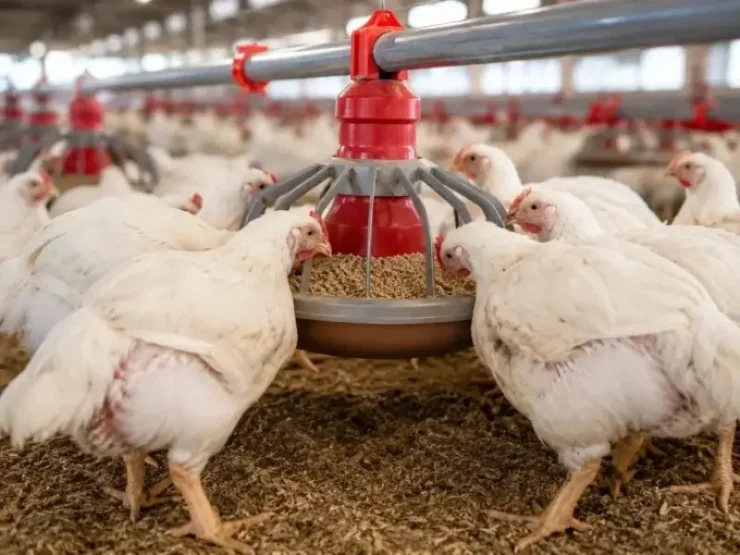
Broiler feeding inside a poultry farm
How FCR Changes the Cost Per Chicken
Of all the factors that influence feed cost per bird, FCR is the one farmers can influence most directly. Even a small change in FCR makes a visible difference. Using the same 2.2 kg bird and the same blended feed price of Rs54 per kg, the numbers shift like this:
- FCR of 1.5: about 3.3 kg of feed per bird, costing roughly Rs178
- FCR of 1.6: about 3.52 kg of feed per bird, costing roughly Rs190
- FCR of 1.7: about 3.74 kg of feed per bird, costing roughly Rs202
- FCR of 1.8: about 3.96 kg of feed per bird, costing roughly Rs214
- FCR of 2.0: about 4.4 kg of feed per bird, costing roughly Rs238
The gap between an FCR of 1.6 and 2.0 is about Rs48 per bird. On a flock of 1,000 birds, that is nearly Rs48,000 lost without the farmer ever noticing a change in the feed price itself. This is why feed efficiency matters just as much as feed price.
Factors That Affect Broiler Feed Cost Per Chicken in Nepal
Several things determine whether a farm lands at the low or the high end of the cost range.
Raw Material Prices
Maize and soybean meal make up the bulk of a broiler ration, and a large share of protein ingredients is imported. When international prices or customs duties rise, feed manufacturers pass the increase on. Feed producers have also lowered prices at times when key inputs became cheaper, which shows how closely feed prices follow raw material markets.
Feed Quality and Formulation
A cheaper feed is not always the lower-cost option. If a feed has poor digestibility or an unbalanced amino acid profile, birds need to eat more of it to reach the same weight. Reading about broiler chicken feed formulation helps farmers understand what is actually inside the bag they are paying for.
Protein Level
Protein is the most expensive part of any ration. Feeds with higher protein cost more per kilogram, but they can improve growth and FCR when used at the right stage. A closer look at high protein broiler feed shows that paying more per kilogram actually saves money per bird.
Feed Additives and Enzymes
Enzymes allow birds to extract more nutrition from the same ingredients, which can reduce the amount of feed needed per kilogram of gain. The role of enzyme formulation in poultry feed is well established, and it is one of the practical ways feed companies help farmers improve efficiency.
Weather and Housing
Hot weather reduces appetite and growth, while cold weather increases feed intake for body warmth. Both can disturb FCR. Farms that invest in a climate-controlled poultry house generally see more stable feed performance across seasons. Good poultry housing systems also reduce stress and feed wastage.
Health and Mortality
A sick bird eats less, grows slower, and sometimes dies after consuming a lot of feed. The cost of that feed is then spread over fewer surviving birds, which raises the cost per chicken sold. Maintaining strong poultry immunity is therefore not just a health measure but a cost control measure as well.
Feed Wastage and Storage
Spilled feed, rodent damage, moisture, and mould all add to the real cost per bird. Even a few percent of wastage across a batch can add thousands of rupees to the final feed bill.
Feed Cost as a Share of Total Production Cost
Feed typically makes up around 60 to 70 per cent of the total cost of raising broilers. The rest is made up of chicks, vaccines and medicines, labour, electricity, litter, and housing costs. This is why a farmer who saves even five percent on feed often sees a bigger improvement in profit than one who saves five percent on any other item.
It also explains why feed is the first place experienced farmers look when a batch underperforms. When the live weight price is Rs220 to Rs250 per kg and feed cost alone is close to Rs92 per kg of live weight, a significant part of the selling price is already committed before any other expense is counted. Prices can also swing sharply with season and demand, so there is rarely room for waste.
How to Reduce Broiler Feed Cost Per Chicken
Lowering feed cost does not mean buying the cheapest feed. It means getting more weight from every kilogram of feed. The following practices make the biggest difference:
- Improve FCR first: Focus on gut health, correct feeding programmes, and stable shed conditions before looking at price alone
- Use stage-specific feed: Switching from starter to grower to finisher at the right age avoids paying for protein the bird does not need
- Reduce wastage: Use feeders of the right height, fill them to the recommended level, and repair leaks and spills quickly
- Store feed properly: Keep bags off the floor, away from moisture, and use them within their shelf life
- Control the environment: Stable temperature, good ventilation, and clean water protect appetite and growth
- Weigh birds regularly: Weekly sampling shows whether growth is on target and lets you act before a poor batch is already finished
- Buy in a planned way: Ordering in advance from a reliable supplier reduces the risk of emergency purchases at higher prices
- Follow good feed management: The principles of feed management for sustainable poultry farming apply directly to keeping cost per bird down
Challenges in Managing Feed Cost in Nepal
Even well-run farms face difficulties when it comes to controlling feed cost:
- Import dependence: A large share of protein ingredients and premixes comes from outside the country, which exposes feed prices to currency and duty changes
- Price volatility: Both feed prices and live chicken prices move with season, festivals, and demand, which makes planning difficult
- Limited record keeping: Many small farms do not track feed consumed against weight gained, so they cannot see where money is being lost
- Disease losses: Mortality increases the effective feed cost per surviving bird
- Climate extremes: Hot summers in the Terai and cold winters in the hills both affect intake and growth
- Access to technical support: Not every farmer has easy access to a poultry nutritionist or a veterinarian
Opportunities for Lowering Feed Cost
There is also real room for improvement across the sector:
- Wider use of local and alternative protein sources to reduce import dependence
- Better use of modern poultry technology such as automated feeders and farm record software
- Growth in antibiotic-free production systems that rely on nutrition and management, as explained in this guide to antibiotic-free poultry farming
- More farmer training on FCR, feed storage, and stage-wise feeding
- Greater use of balanced rations, as described in this article on a balanced diet for poultry
Tips for Farmers to Keep Feed Cost Under Control
Farmers who want a clearer grip on feed cost per chicken should keep these habits:
- Record the exact amount of feed given every day, and the feed left over
- Calculate FCR at the end of every batch and compare it with the previous one
- Compare feeds on cost per kilogram of live weight, not just the price on the bag
- Choose feed from reputable manufacturers that clearly label protein and energy levels
- Check feed for smell, colour, and moisture before it is poured into the feeders
- Keep drinkers clean and working, since water intake and feed intake rise and fall together
- Review mortality records, because lost birds mean lost feed
- Talk to a poultry nutritionist or veterinarian when numbers do not match expectations
Conclusion
Broiler feed cost per chicken in Nepal is not a fixed number. It sits somewhere around Rs190 to Rs240 depending on feed prices, FCR, market weight, and how well the flock is managed. What matters is understanding how that figure is built, because once a farmer can see where the money goes, it becomes much easier to protect it.
With feed accounting for the largest share of production cost, the farms that stay profitable are usually not the ones that find the cheapest bag. They are the ones that track their numbers, choose feed that performs, keep their birds healthy and comfortable, and avoid waste at every step.
SB Group’s Jio Feed range is developed to support exactly this kind of efficiency, giving Nepali poultry farmers stage-specific broiler feeds that deliver consistent growth and a dependable feed conversion ratio. For anyone serious about improving margins, a close look at feed cost per chicken is one of the best places to begin.